Guide
Menu engineering guide
8 min read
Menu engineering is the practice of analyzing each dish by two measures — how often it sells and how much margin it earns — then redesigning the menu to push profit upward. You plot items into four groups, stars, plowhorses, puzzles, and dogs, and take a specific action for each. Done well, it raises the average check without raising prices across the board. This guide explains the categories and the moves that follow.
The two numbers behind every dish
Menu engineering rests on two metrics. The first is popularity, usually measured as menu mix — the share of total sales a dish represents within its category. The second is profitability, best measured as contribution margin in dollars, the amount left after the cost of the dish. Pull both from your point-of-sale and your plate costs for a set period, a month is a sensible window. Plotting popularity against profitability tells you something a sales report alone cannot: which dishes earn their place, which sell well but barely pay, and which look good on paper but no one orders. Those two numbers, not opinion, drive every decision that follows.
- Menu mix measures how often a dish sells within its category
- Contribution margin measures the dollars a dish earns per sale
- Pull both from your point-of-sale and plate costs over about a month
See: Menu engineering, Menu mix.
The four categories
Plotting both metrics sorts every dish into four groups. Use the chart below to place each dish once: popularity runs left to right, profitability runs bottom to top.
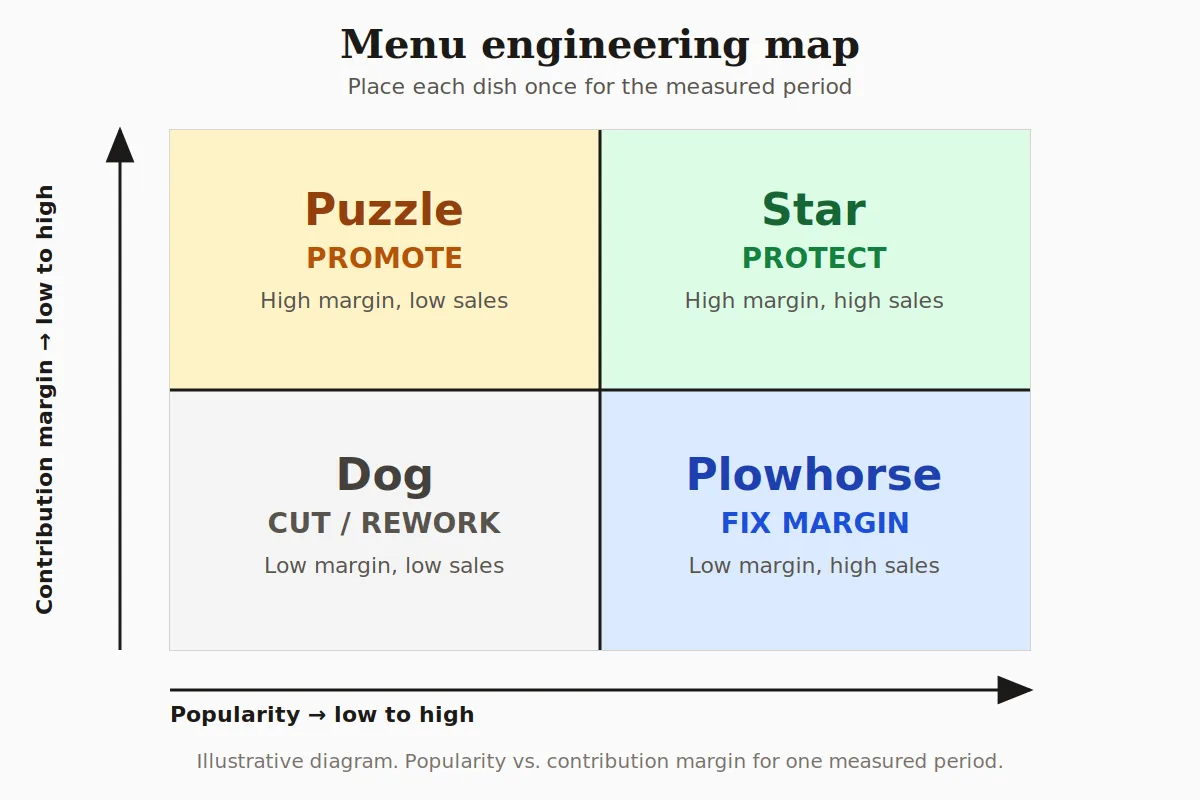
Stars are high popularity and high margin — your best performers, the dishes to protect and feature. Plowhorses are high popularity but low margin — guests love them, but they pay little, so the work is to lift their margin. Puzzles are high margin but low popularity — profitable when sold, but overlooked, so the work is to sell more of them. Dogs are low on both — they take up space, complicate the kitchen, and rarely sell. Sorting honestly is the hard part, because every operator has a favorite that turns out to be a dog. Let the numbers, not affection, decide the category.
Illustrative example only — not client data
| Illustrative dish | Popularity | Margin | Category | First move |
|---|---|---|---|---|
| Roast chicken plate | High | High | Star | Protect, feature at top of section |
| Spaghetti bolognese | High | Low | Plowhorse | Trim portion cost, modest price nudge |
| Grilled octopus | Low | High | Puzzle | Better placement, stronger description, server push |
| Fried cheese starter | Low | Low | Dog | Remove or reinvent |
What to do with each category
Each category has a clear play. Protect stars: keep them on the menu, give them prime placement, and resist over-tinkering with a dish that works. Fix plowhorses by lifting margin without scaring off the guests who love them — trim portion cost, adjust the garnish, or nudge the price modestly. Promote puzzles through better placement, a stronger description, server recommendations, or a small price reduction to test demand. Cut or rework dogs: remove them, or reinvent the dish into something with better economics. The goal is not to slash the menu but to rebalance it so the items earning the most also get the most attention from your layout and your staff.
Use layout and language to steer choices
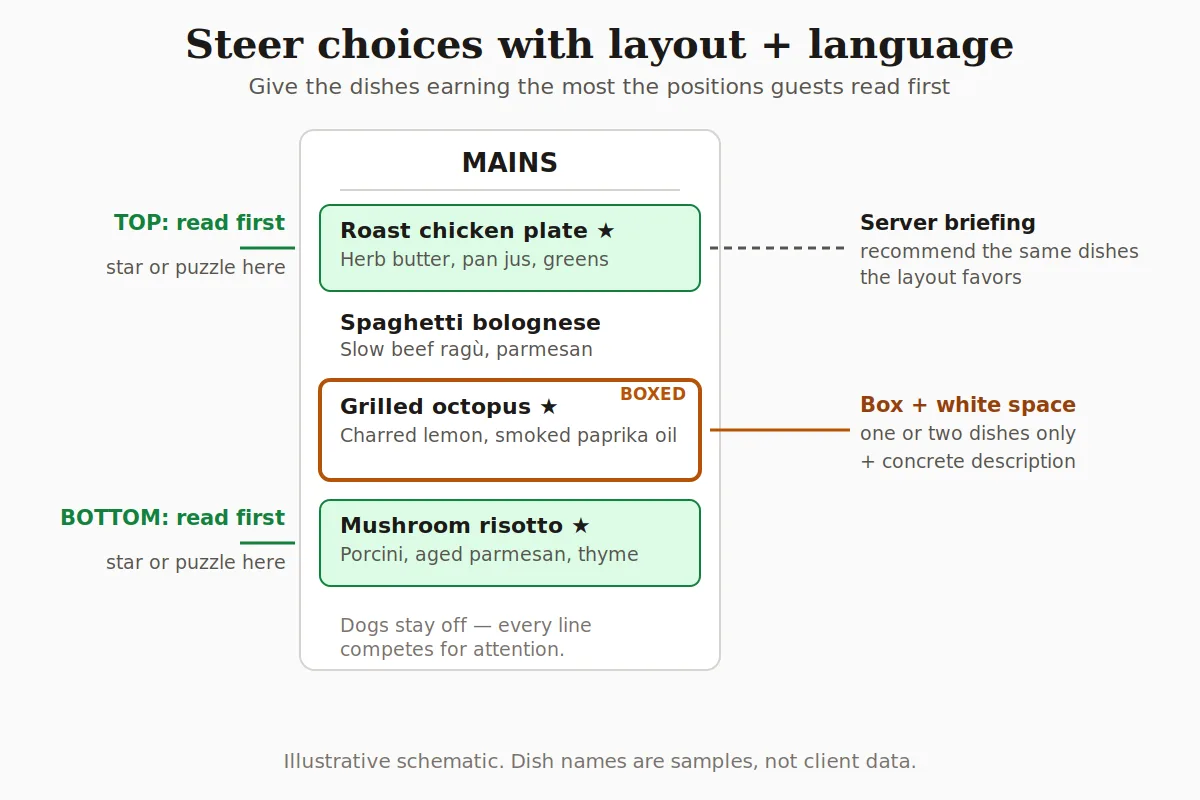
Once you know your stars and puzzles, the menu's design becomes the lever. Guests gravitate to whatever the layout emphasizes, so place high-margin dishes in the positions that get read first — the top and bottom of each section — and give one or two a box or surrounding white space. Strengthen their descriptions with concrete, appetizing language so they win the scan. Keep dogs off the menu entirely rather than burying them, since every line competes for attention. Pair the redesign with a short server briefing so the team recommends the same dishes the layout favors. Design and service working together move the menu mix far more than either does alone.
Make it a repeatable cycle
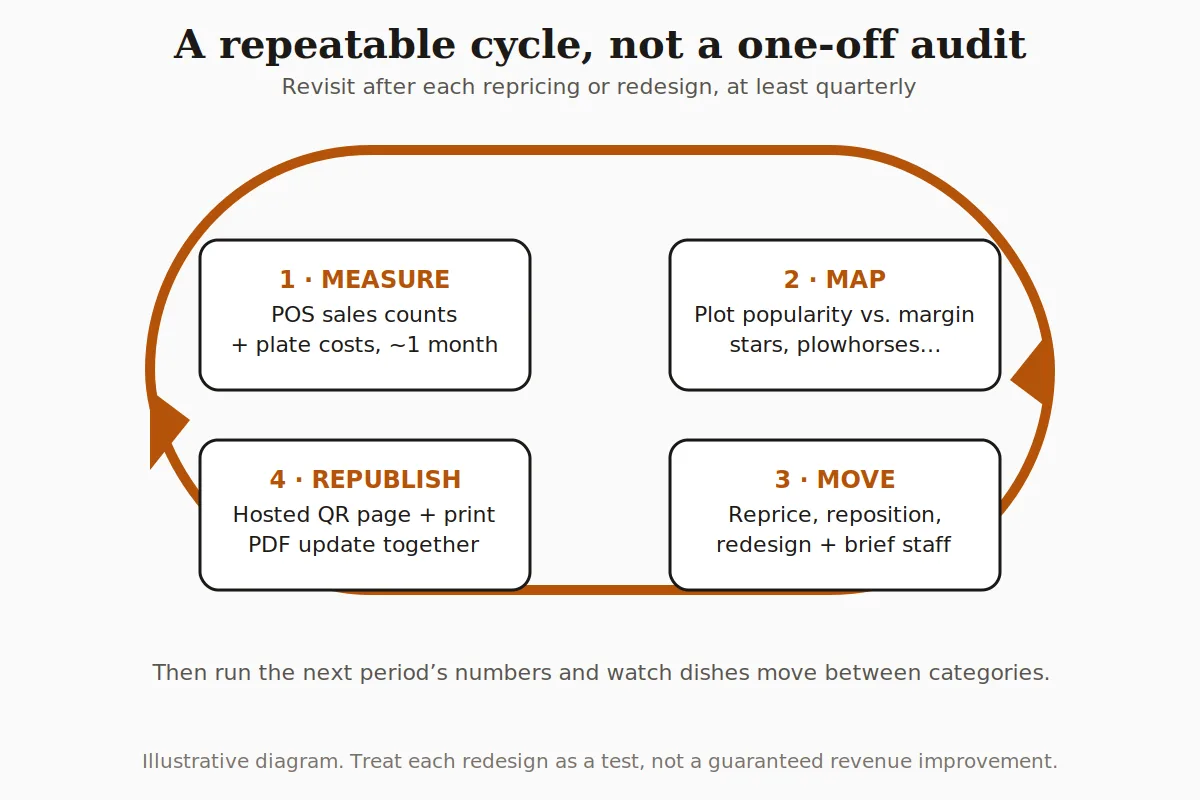
Menu engineering is not a one-time audit; it is a loop. After you reprice and redesign, run the next period's numbers and see whether dishes moved between categories — a promoted puzzle should climb toward star, a repriced plowhorse should earn more. Costs and tastes shift, so revisit the analysis on a regular cadence. Keeping the menu as editable data makes the cycle practical: with MenuCrafters you adjust prices, swap a dog for a new dish, and reposition items, then republish so the hosted QR page and the print-ready PDF update together. The menu becomes a living instrument you tune toward profit rather than a document you reprint once a year.
Limitations and assumptions
Menu-engineering categories describe one measured period and do not prove why an item sold. Results change with season, placement, availability, promotions, guest mix, price, and service execution. Use complete item-level sales and recipe-cost data, choose a clear observation window, preserve the raw export, and treat any redesign as a test rather than a guaranteed revenue improvement.
Frequently asked questions
- What is menu engineering in simple terms?
- It is sorting every dish by how often it sells and how much profit it earns, then redesigning the menu to sell more of the profitable items. Dishes fall into stars, plowhorses, puzzles, and dogs, each with a specific action.
- What data do I need to start?
- Sales counts per dish from your point-of-sale and the contribution margin of each dish from your plate costs, over about a month. Those two numbers let you plot popularity against profitability.
- How often should I redo the analysis?
- Treat it as a recurring cycle rather than a one-off. Revisit after each repricing or redesign and at least quarterly, since costs and guest preferences shift and dishes move between categories over time.